12.9.2025
Apply to Betaworks’ Spring ‘26 AI Camp: Agent Systems



.jpg)
We’re excited to announce that our next Camp will be focused on Agent Systems.
Apply here (but you should probably read this whole post first)
An agent system is a system (that usually takes the form of a company) where agentic AI elements interact and compose an integrated whole. We’re interested in companies that have been newly designed assuming agentic AI as a core tenet.
Companies built as agent systems take many of the most powerful properties of machine intelligence and embody them at the systemic level:
- Perception and Memory: Synthesize context from multiple sources and maintain memory across interactions
- Autonomous Planning: Independently develop multi-step strategies toward abstract goals
- End-to-end Execution: Complete entire workflows without human intervention, using whatever tools necessary
- Adaptability and Self Evaluation: Assess its own performance and adjust course
A big “canary in the coal mine”-like signal that the era of Agent Systems is worth exploring comes from the world of agentic coding. The level of software task complexity achievable by AI agents in the past 24 months has exploded.
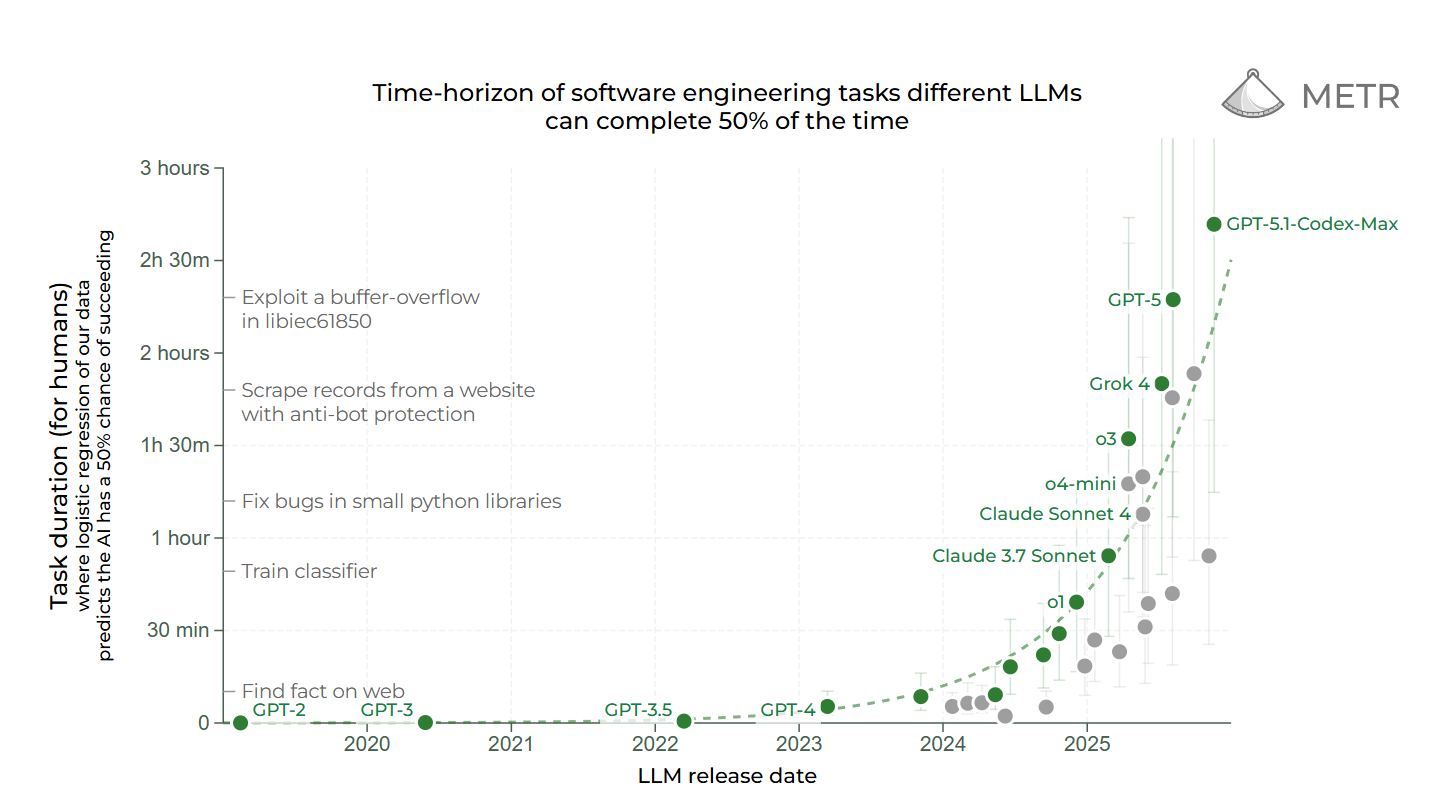
And while a ton of this is due to an increase in raw power from pre and post-training, additional power comes from the systems and environments that exist to enable the models at the core, everything from MCP like systems to Claude Code/Jules/Codex.
In 2025, we’ve seen a major shift in the possibilities and behavior around these existing tools – it’s now commonplace to wake up to an interesting useful surprise that was baking overnight, or to be on a call with a founder whose software is changing and being built while they chat with us.
All of this should extend beyond coding. Agent Systems should be able to deliver useful work to you in all domains of life, from leisure, to finance, to healthcare, and more.
So what are we looking for? The following list is a menu of items rather than a list of criteria. Spikiness across one or two of these attributes makes for an interesting application to us.
1. The Thing, Not the Tool
We're interested in complete solutions to actual problems – products that step into existing workflows providing a full “thing” rather than another tool that does elements of the thing.
What this looks like:
- Not "software for lawyers" → an AI law firm
- Not "recruiting tools" → an AI staffing and recruiting agency
- Not "accounting software" → an AI big 4 accounting firm
Less regulated industries make this easier, but if you’ve figured something out in a regulated industry you can also build a big moat. The emergence of new categories is inevitable.
Question for founders: Are you building a tool for X, or are you becoming X?
2. End-to-End Autonomous Execution
The problem: Right now, most agents do "middle to middle" work—they help with parts of tasks but humans still orchestrate.
What we want: Multi-agent systems that can accomplish complete tasks autonomously
- Loop of trying, reasoning, using tools until task completion
- Systems that can recover from failures and continue
- True autonomy, not just automation
The test: Can it complete the entire job without a human checking in at every step? Admittedly, this is still the hardest thing to achieve. We want to see where you are on the bleeding edge, what you’ve been able to accomplish. Even if you need to make compromises to get things to really work, show us the most complex work your systems can accomplish.
3. Memory & Sophisticated Context Management
The challenge: Finite context windows, knowing what information matters when
What we're looking for:
- Novel approaches to memory and retrieval, either new systems you’ve made, or even hacks you’ve discovered within your domain of choice
- Systems that know when to remember and when to forget, that self tune for context depth
- Reflection and metacognition capabilities: does your system get better on attempt 3 vs. attempt 1?
4. Ambient Intelligence / Proactive Systems
The insight: Great agent systems understand timing—when to be active, when to fade away, when to interrupt, when to run silently. Because of the way they have been trained and architected, AI Agent Systems often have a terrible awareness of time. But awareness of sequencing, causality, and the passage of time are a key part of the way an Agent System can actually exist in and interact with the world.
What this means:
- Intelligent and usefully proactive interfaces, that anticipate needs
- Background autonomy that doesn't require constant attention
- Systems that understand context well enough to know when they're needed and especially when they are not
Not: Chatbots waiting for commands
Instead: Systems that actively manage workflows and only surface when necessary
5. Everywhere Products
The principle: If you build an agent system, it must be able to escape containment and exist where users need it. Agent Systems are both entities that do things and also the place where the stuff is done; the environments and playgrounds with the tools and affordances that enable the systems to work.
Requirements:
- Really be (or expect/plan to be) everywhere: provide APIs, SDKs, Natural language interfaces, user facing interfaces
- Ability to integrate into existing tools and workflows
- Ideally: systems that can write code for themselves to integrate with new platforms
- Platform-agnostic, interface-fluid, assumes the existence of other agent systems
The vision: Agents swarming around the internet with tasks.
Why Now?
Camp is a thematic investment program that’s been running since 2016. Our first camp focused on NLP and Chatbots (HuggingFace was in that camp), and we’ve since tapped themes like computer vision, synthetic media, AI copilots, vertical AI, and native AI interfaces.
What we've attempted to do in our thematic investment business is to systematically explore facets of applied AI, from agentic autonomous systems, to the way it's interfaced closest to the end user. The frontier of current capabilities is radically different than it was just two years ago. If a startup has a durable edge in a new magical capability on the frontier of AI, it's probably a good bet. In practice though, new startups are much more likely to be implementing the frontier rather than pushing the science as research.
The baseline of capability has moved so much that we think that the companies we invest in the next two years will look dramatically different than the ones we invested in just two years ago, because if you're getting started in 2026, you can take that baseline as a presumption.
How Camp Works
Priority application deadline: Wed 12/24/25
EXTENDED deadline: Fri 1/9/26
Camp is a 12-week, in-person program at Betaworks in NYC. International companies are welcome to apply but must be willing to relocate to New York for at least a portion of the program.
Key Dates: March 2 through May 15, 2026. Demo Day takes place the week of May 4th.
Participating companies receive:
- Up to $500K in investment
- Dedicated 1:1 time with Betaworks partners
- Support from experts in product, GTM, design, business operations, and fundraising
- Weekly programming: workshops, founder roundtables, pitch practice and speed-dating with investors
- Mentorship from industry veterans and a built-in community of fellow founders
- Physical office space in NYC’s Meatpacking District
- A capstone Demo Day in front of a room of the best investors in NYC and beyond
Deal specifics: Each participating company will receive investment up to $500k. Betaworks Ventures will invest up to $250k on an uncapped SAFE note with a 25% discount, and receive a 5% common stock stake in the business. Our syndicate partners will be adding up to $250k total on uncapped SAFEs with the same 25% discount.
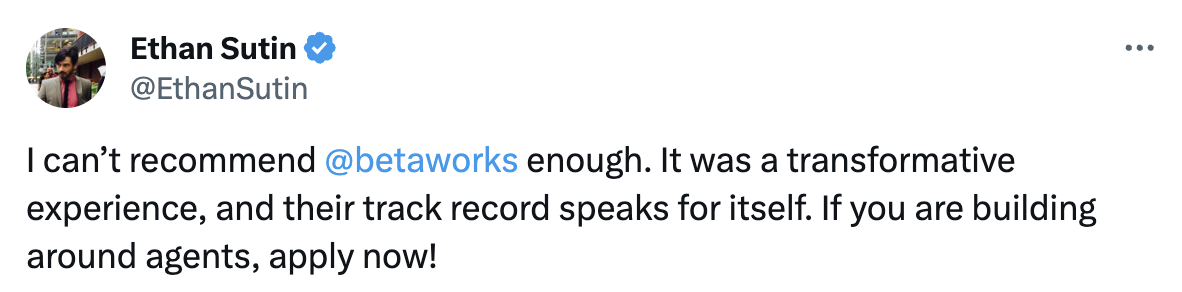
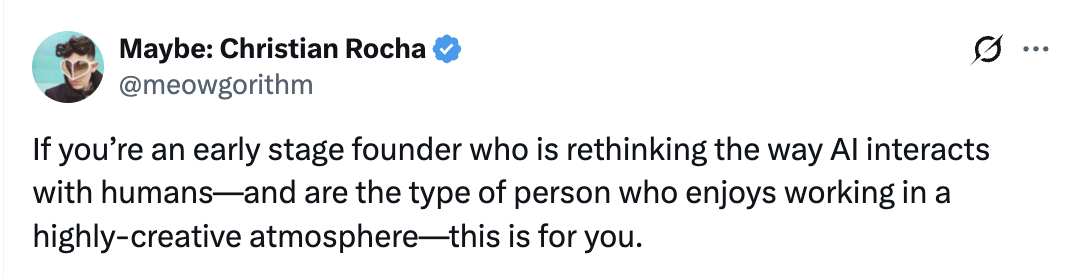
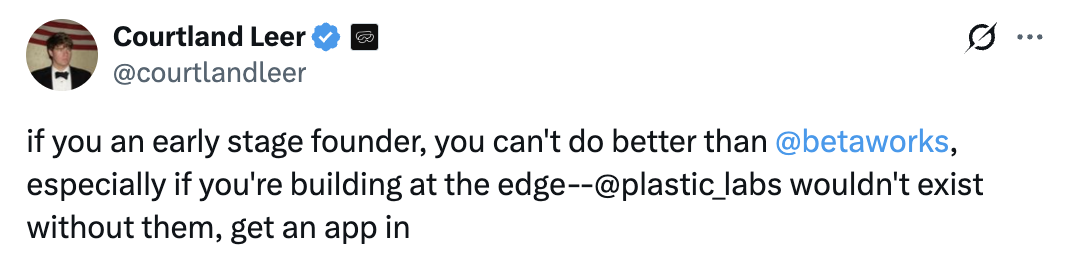
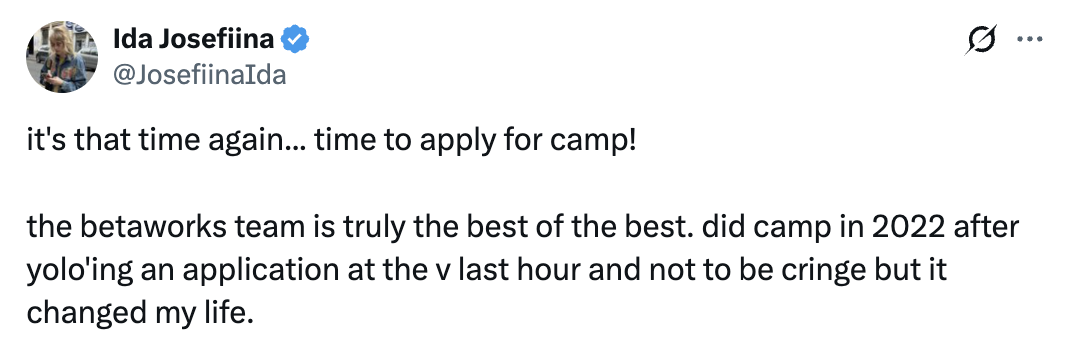
What founders are saying about Camp: